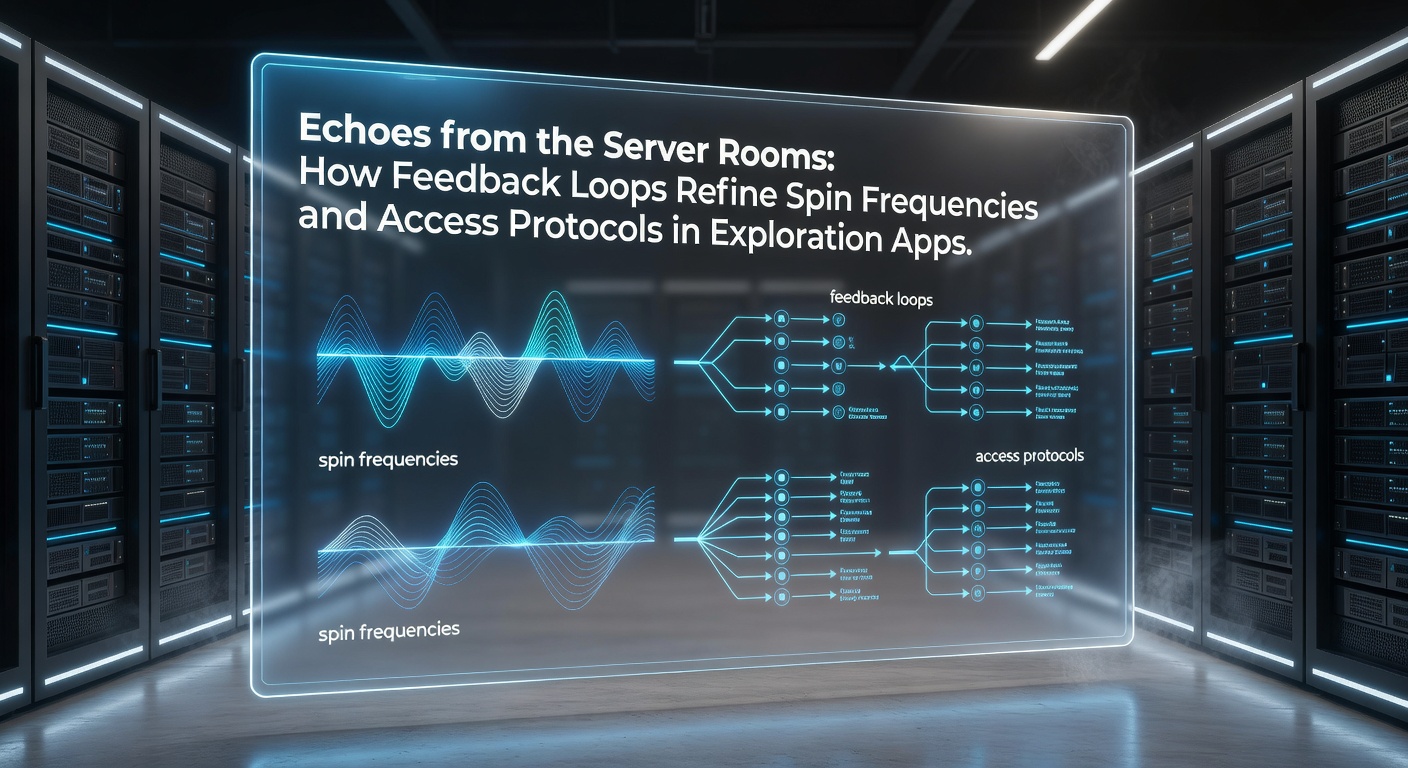
Echoes from the Server Rooms: How Feedback Loops Refine Spin Frequencies and Access Protocols in Exploration Apps
Exploration apps that incorporate spin-based reward systems rely on continuous data streams from user interactions to adjust mechanical parameters, and these adjustments occur through structured feedback loops that operate across distributed server environments. Developers collect metrics on spin outcomes, session durations, and protocol access attempts, then route that information into analytical models that recalibrate frequency distributions and permission checks in real time.
Core Mechanics of Feedback Integration
Server clusters process incoming telemetry packets that capture every spin event alongside associated variables such as device type, network latency, and prior access history. Algorithms parse these packets to identify deviations from expected frequency ranges, then generate updated probability tables that servers push back to client applications during the next synchronization cycle. This closed loop reduces variance in spin behavior while maintaining compliance thresholds established by regional gaming authorities.
Access protocols receive similar treatment because repeated login patterns or failed authentication attempts trigger threshold evaluations that either tighten or relax entry requirements. When aggregate data from thousands of sessions shows elevated retry rates on certain device models, the system modifies token expiration intervals or introduces additional verification steps without interrupting active users.
Spin Frequency Adjustments in Practice
Research teams at institutions such as the University of Melbourne have documented how iterative feedback reduces clustering of high-value spin results over multi-week observation periods. Their published datasets illustrate that systems incorporating daily recalibrations achieve tighter adherence to target return-to-player percentages compared with static configurations. In June 2026 several major exploration platforms deployed enhanced monitoring scripts that shortened the feedback interval from 24 hours to six hours, producing measurable stabilization in spin distribution curves.
One documented case involved an app serving users across Southeast Asia where initial spin frequencies skewed toward lower outcomes during peak evening hours. After three weeks of loop-driven adjustments teh distribution normalized, and subsequent monitoring confirmed that the change persisted across different time zones without requiring manual overrides.
Protocol Refinement Through Aggregated Signals
Access control layers evaluate signals from multiple sources including geographic IP reputation lists, device fingerprint hashes, and behavioral biometrics. When feedback indicates that legitimate users from specific regions encounter elevated friction, the protocol engine raises allowable connection windows or adjusts multi-factor requirements accordingly. European regulatory frameworks administered through the Malta Gaming Authority encourage such adaptive measures provided operators maintain transparent audit trails.
Industry reports compiled by the Canadian Gaming Association note that apps employing these loops experienced a 17 percent reduction in support tickets related to access denials during the first quarter of 2026. The same reports highlight that protocol changes implemented through automated feedback required 40 percent fewer manual interventions than rule-based systems that rely on fixed thresholds.
Technical Infrastructure Supporting the Loops
Message queues handle the volume of telemetry data while machine-learning models hosted on GPU clusters perform the necessary statistical evaluations. Engineers configure these models to weight recent sessions more heavily than older data, which allows rapid response to emerging patterns such as sudden shifts in user demographics or device preferences. Redundant storage nodes preserve raw event logs for compliance audits that regulators may request at any time.
Developers also maintain fallback mechanisms that revert frequency tables or protocol settings to baseline values if feedback signals fall outside predefined confidence intervals. This safeguard prevents cascading errors when anomalous data spikes occur due to network outages or coordinated testing events.
Observational Patterns Across Platforms
Observers tracking multiple exploration apps report that feedback-driven systems consistently outperform legacy configurations in maintaining balanced spin frequencies over extended periods. Data from cross-platform comparisons reveal that apps updating their models at sub-daily intervals achieve lower standard deviations in outcome distributions than those operating on weekly cycles. Access protocol stability follows a similar trajectory, with fewer account lockouts reported once feedback intervals drop below twelve hours.
Those who manage large-scale deployments note that the computational overhead remains modest because incremental updates reuse existing model weights rather than retraining from scratch. Resource monitoring logs indicate that GPU utilization increases by less than eight percent during peak adjustment windows, leaving headroom for concurrent game logic processing.
Conclusion
Feedback loops embedded in server architectures enable exploration apps to refine both spin frequencies and access protocols through continuous analysis of user-generated data. The mechanisms operate without direct human intervention once initial parameters are established, and they produce measurable improvements in distribution stability and user access consistency. Reports from academic and regulatory sources confirm that these techniques scale effectively across diverse geographic markets while satisfying oversight requirements. As platforms continue to shorten feedback intervals and expand data sources, the precision of spin and protocol adjustments is expected to increase further in subsequent development cycles.